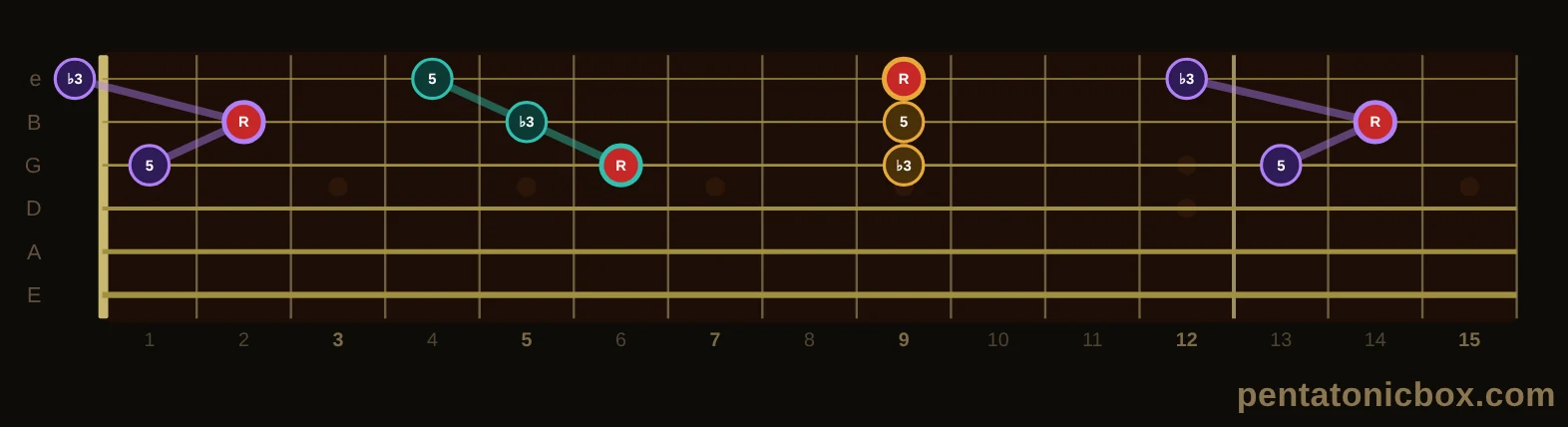
The C# minor triad is three notes: C♯ (root), E (minor (♭) 3rd) and G♯ (5th). On guitar you play one note on each of three neighboring strings, and the chord has three shapes, its inversions, that repeat up the neck. Below are all of them on every string set, from the open strings to the 15th fret, so you can play C♯m anywhere on the fretboard.
| Inversion | Lowest note | Notes, low string to high |
|---|---|---|
| Root position | C♯ | C♯ · E · G♯ |
| 1st inversion | E | E · G♯ · C♯ |
| 2nd inversion | G♯ | G♯ · C♯ · E |
All three use the same notes, C♯, E and G♯. Moving up one string set, the shapes come in order (root position, 1st inversion, 2nd inversion) and then repeat 12 frets higher.
Root position: frets 4–6 · 1st inversion: fret 9 · 2nd inversion: frets 0–2 and frets 12–14. Open C♯m triads on G–B–e in the fretboard →
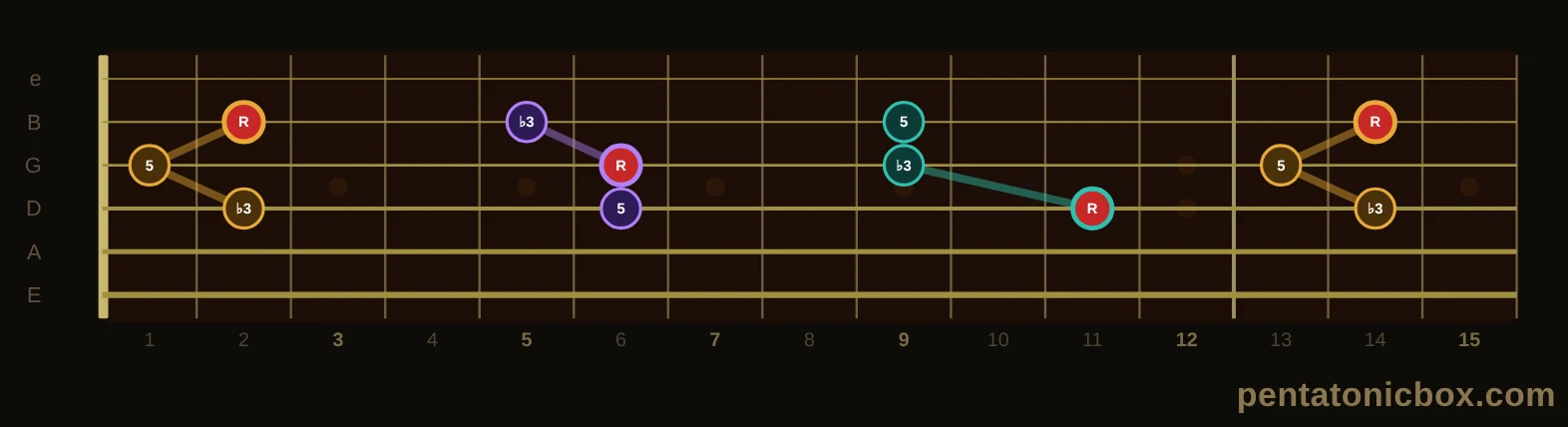
Root position: frets 9–11 · 1st inversion: frets 1–2 and frets 13–14 · 2nd inversion: frets 5–6. Open C♯m triads on D–G–B in the fretboard →
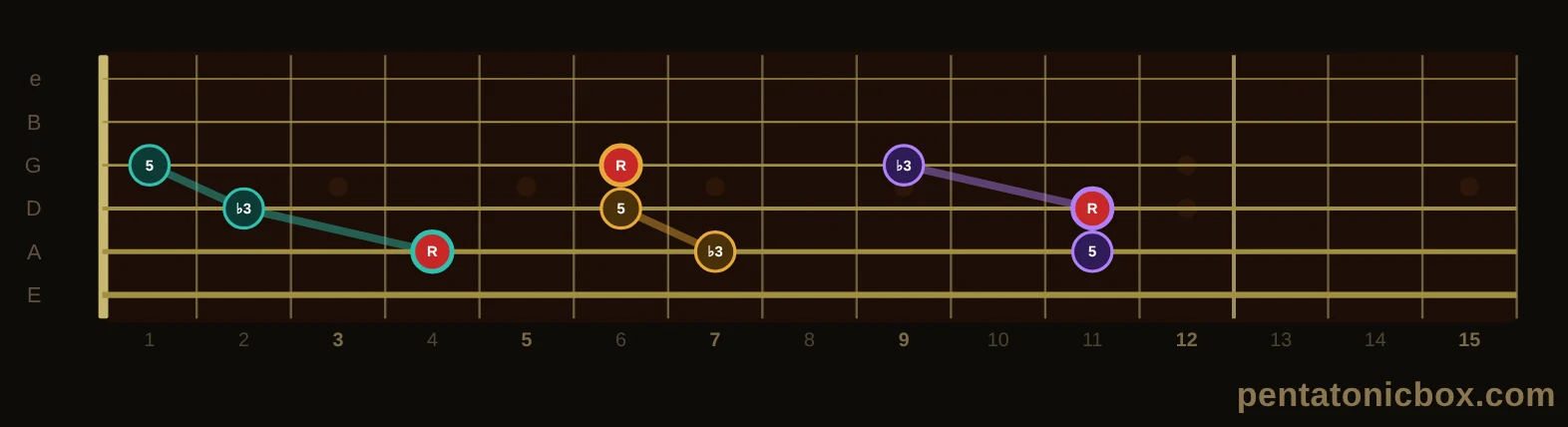
Root position: frets 1–4 · 1st inversion: frets 6–7 · 2nd inversion: frets 9–11. Open C♯m triads on A–D–G in the fretboard →
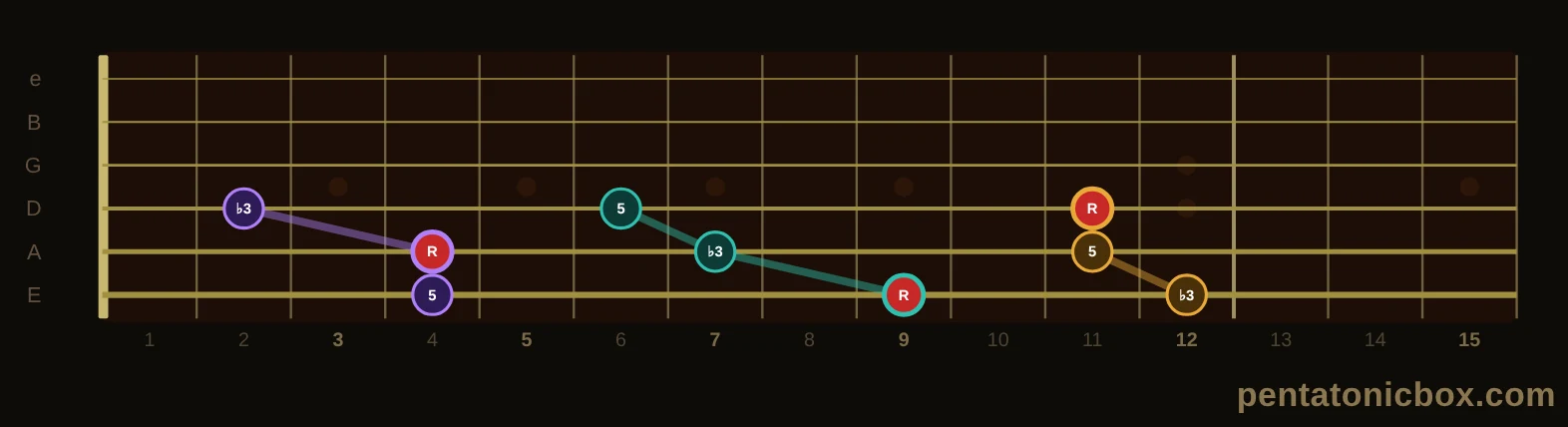
Root position: frets 6–9 · 1st inversion: frets 11–12 · 2nd inversion: frets 2–4. Open C♯m triads on E–A–D in the fretboard →
These are the triads built from the C♯ minor scale. Each major and minor chord links to its own triad page, so you can find the shapes for a whole progression.
All three notes of C♯m are in the C♯ minor pentatonic scale, so every pentatonic box already holds C♯m triad shapes. Spread the same notes across all six strings and you have the C♯m7 arpeggio. For the bigger chord shapes behind these triads, see the CAGED system, and for every triad type, the guitar triads guide.
Minor triads in other keys: C minor · D minor · Eb minor · E minor · F minor · F# minor · G minor · G# minor · A minor · Bb minor · B minor.
Guides: pentatonic boxes guide · connecting the 5 boxes · breaking out of the box · learning the fretboard notes · mixing major and minor pentatonic · left-handed scale charts · guitar modes explained.
A C# minor triad has three notes: C♯, E and G♯ — the root, the minor (♭) 3rd and the 5th.
Twelve core shapes: 3 inversions (root position, 1st and 2nd inversion) on each of the 4 string sets. Each shape repeats 12 frets higher.
One note. C# major uses the major 3rd (E♯); C# minor lowers it one fret to the minor 3rd (E). The root and 5th stay the same.
On the top three strings, G–B–e, with the shape at 1-2-0. Then connect the three inversions up the neck before moving to the lower string sets.