How to Connect the 5 Pentatonic Boxes

The problemStuck soloing in Box 1
The fixUse the notes two boxes share
Shown inA minor pentatonic
Works inEvery key, same shapes

Most guitarists learn Box 1 of the pentatonic scale and then live there for years. The way out is simpler than it looks: the five boxes overlap, and each box shares one side with the next. Those shared notes are a bridge. Learn where they are and you can slide from one box into the next without stopping, and the whole neck opens up one step at a time.

Box 1 and Box 2: The Shared Notes Are the Bridge

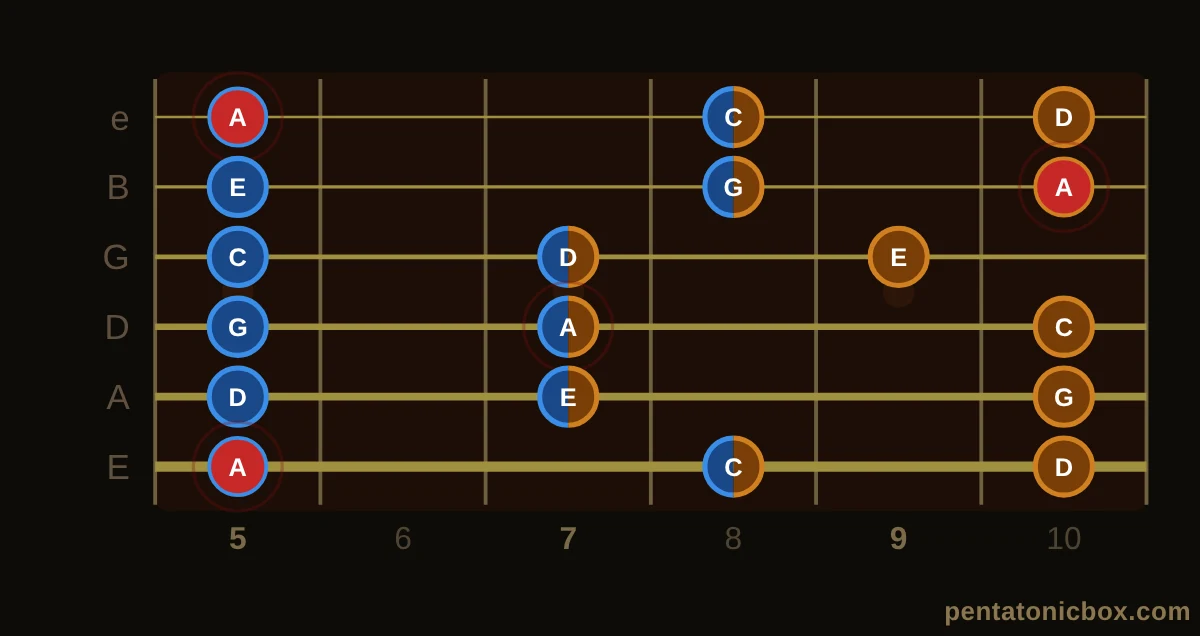
Here are Box 1 (blue) and Box 2 (orange) of A minor pentatonic played together. The split notes belong to both boxes: they are the top of Box 1 and the bottom of Box 2 at the same time.

Box 1Box 2Root (A)
A minor pentatonic Box 1 and Box 2 together on guitar, shared notes in both colors

Shared notes: low E string fret 8; A string fret 7; D string fret 7; G string fret 7; B string fret 8; high e string fret 8. Open Box 1 + 2 in the fretboard →
How to Connect Box 1 and Box 2, Step by Step

  1. Know Box 1 cold. Play it up and down from the low E string to the high e, starting and ending on the root (A).
  2. Learn Box 2 on its own, the same way, until you can play it without looking.
  3. Find the shared notes. Play only the split notes in the diagram above, low string to high. These are the notes you will use to change boxes.
  4. Slide across. Play Box 1 up to the G string, then slide your finger up to the next shared note and finish the run in Box 2. Then come back down the same way.
  5. Improvise across both. Over an A minor backing track, start a phrase in Box 1 and end it in Box 2. Aim to land on a red root note.
Practice Box 1 + Box 2 in the Interactive Fretboard →

Free: both boxes in any key, with every root marked. No signup.

Pentatonic scale printable charts, all keys
Free printable
All 26 charts in one PDF

Every minor and major pentatonic key, plus fretboard notes and CAGED. One download, print the keys you need.

Download all charts All 26 free charts →

Connecting All 5 Boxes

Every pair works the same way. Once Box 1 and 2 feel easy, add one pair at a time. After Box 5 the pattern starts again: Box 5 connects back into Box 1, 12 frets higher.
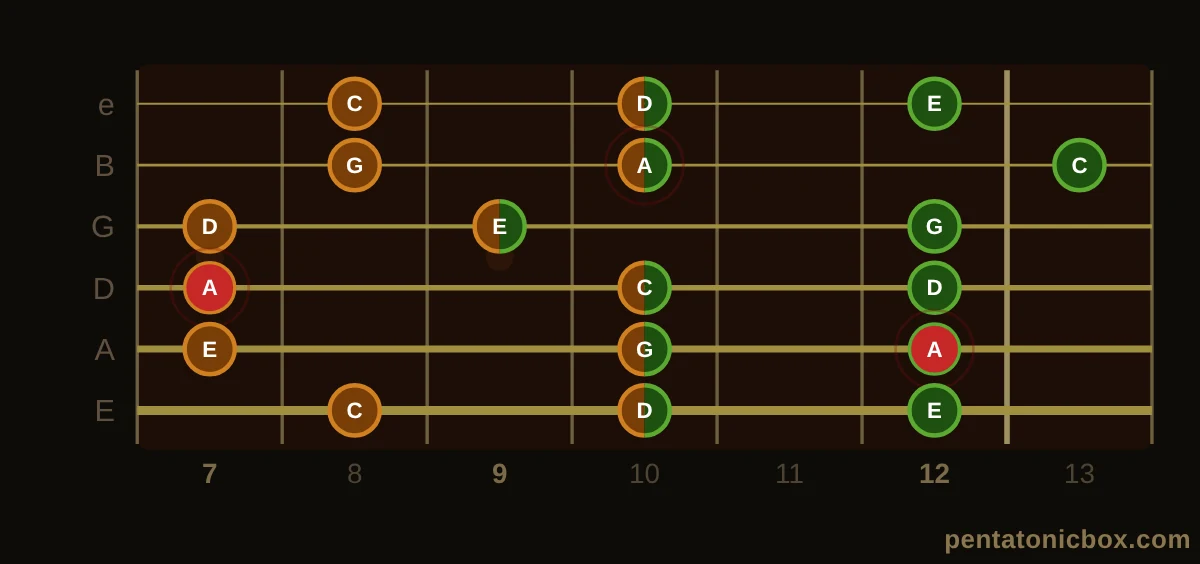
Box 2 → Box 3 (frets 7–13)

A minor pentatonic Box 2 and Box 3 together on guitar, shared notes in both colors

Shared notes: low E string fret 10; A string fret 10; D string fret 10; G string fret 9; B string fret 10; high e string fret 10. Open Box 2 + 3 in the fretboard →
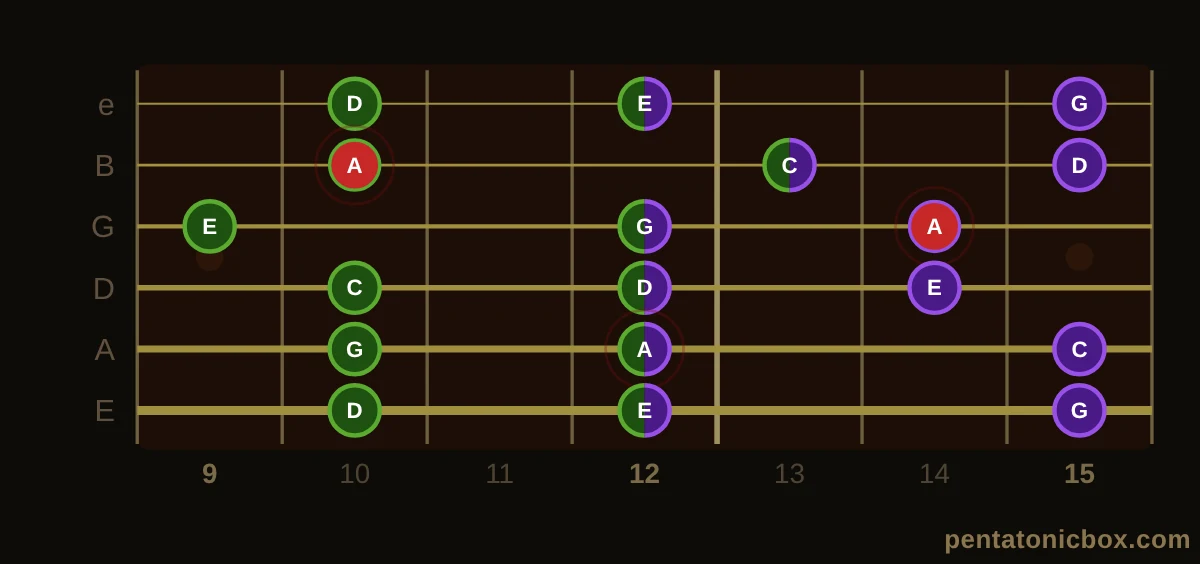
Box 3 → Box 4 (frets 9–15)

A minor pentatonic Box 3 and Box 4 together on guitar, shared notes in both colors

Shared notes: low E string fret 12; A string fret 12; D string fret 12; G string fret 12; B string fret 13; high e string fret 12. Open Box 3 + 4 in the fretboard →
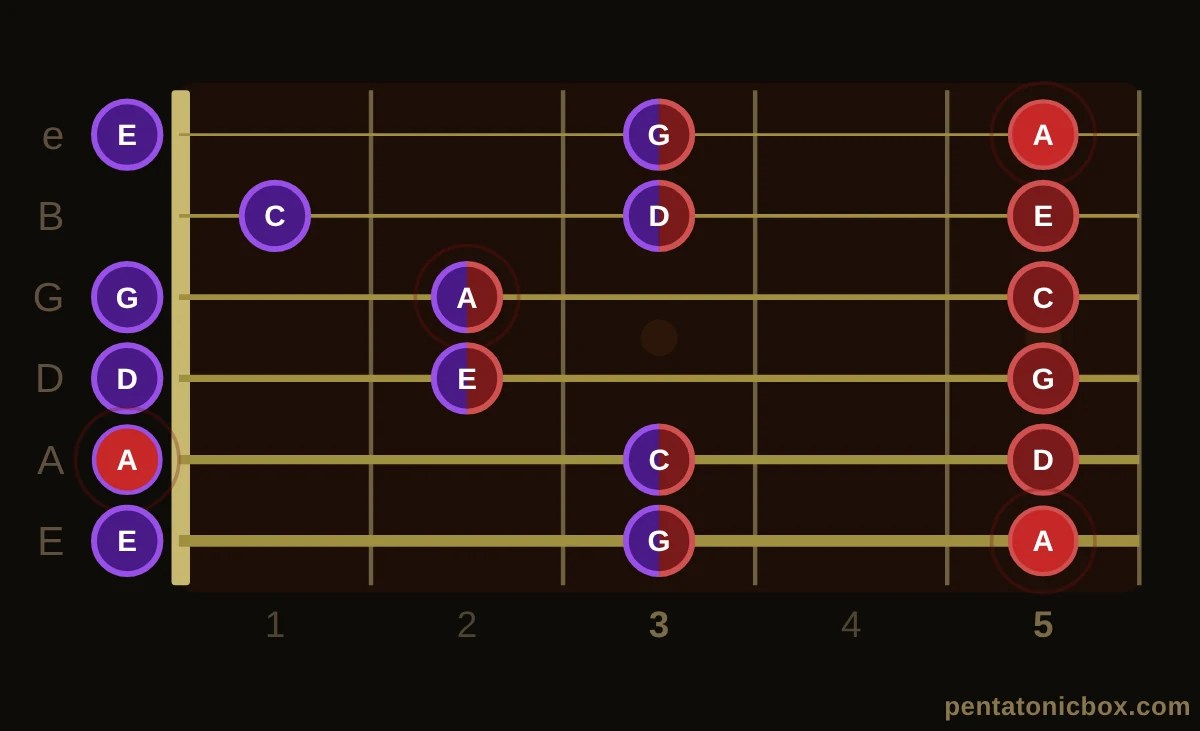
Box 4 → Box 5 (frets 0–5)

A minor pentatonic Box 4 and Box 5 together on guitar, shared notes in both colors

Shared notes: low E string fret 3; A string fret 3; D string fret 2; G string fret 2; B string fret 3; high e string fret 3. Open Box 4 + 5 in the fretboard →
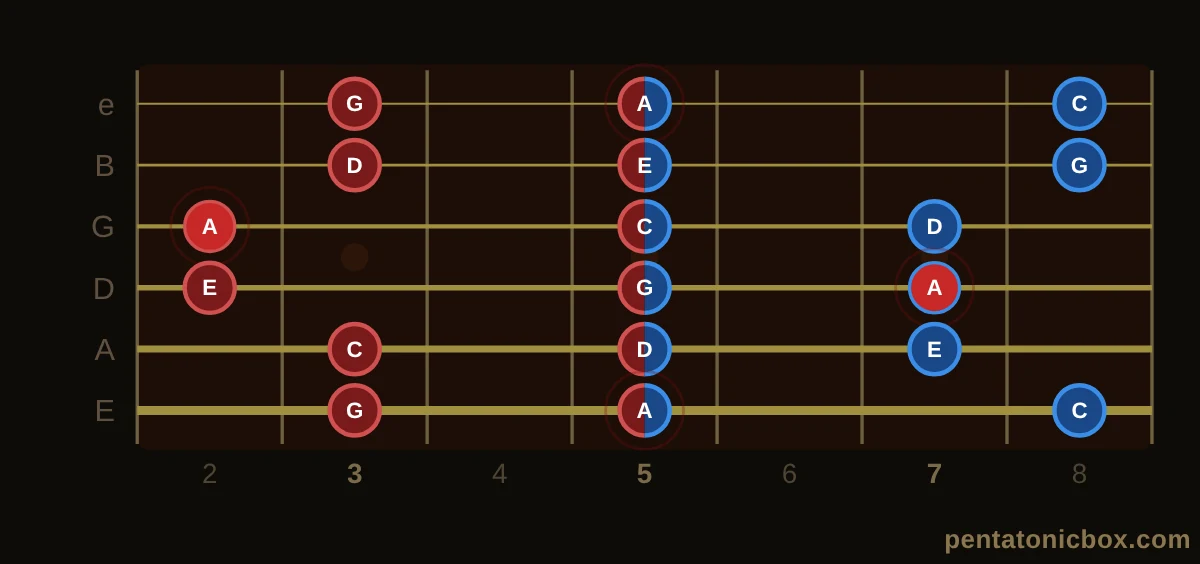
Box 5 → Box 1 (frets 2–8)

A minor pentatonic Box 5 and Box 1 together on guitar, shared notes in both colors

Shared notes: low E string fret 5; A string fret 5; D string fret 5; G string fret 5; B string fret 5; high e string fret 5. Open Box 5 + 1 in the fretboard →

All 5 Boxes on One Neck

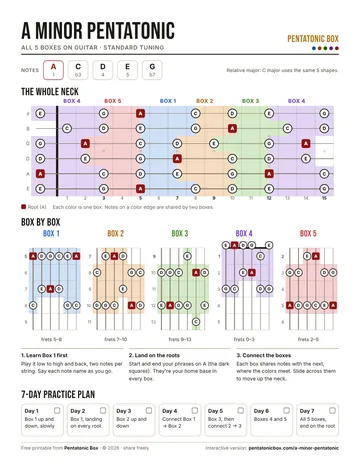
Put the pairs together and you have one continuous scale from the open strings to the 15th fret. Each color is one box; every note sits in at least one box, and the overlaps are where you move between them.
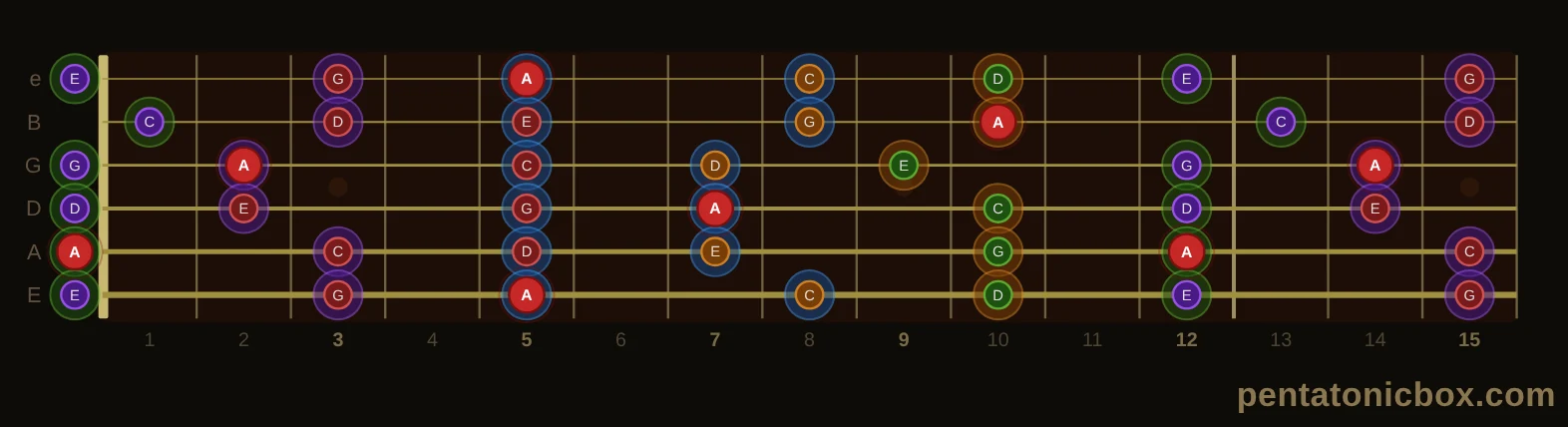
A minor pentatonic, all 5 boxes connected across the neck from the open strings to fret 15

A Practice Routine for Connecting the Boxes

  1. One pair a day. Monday Box 1–2, Tuesday Box 2–3, and so on. Five minutes per pair is enough.
  2. Same lick, two boxes. Play a short phrase in Box 1, then find the same notes in Box 2. This trains your eyes to see notes, not shapes.
  3. Change keys. The shapes do not change in other keys; they only move. Try the same pairs in E minor and G minor.
  4. Next step: once the boxes connect, start breaking out of the box with slides, bends and notes outside the scale.

Frequently Asked Questions

How do I connect pentatonic box 1 and 2?

Use the notes the two boxes share. The top notes of Box 1 are the bottom notes of Box 2, so you can slide from Box 1 into Box 2 on any string and keep playing without stopping.

Why are the pentatonic boxes numbered 1 to 5?

Each box is one position of the same five-note scale. Box 1 starts on the root on the low E string, and Boxes 2 to 5 follow up the neck before the pattern repeats 12 frets higher.

Do the pentatonic boxes connect the same way in every key?

Yes. The shapes and their order never change; only the starting fret moves with the key.

How long does it take to connect all 5 pentatonic boxes?

Most players can connect one new pair a week with five to ten minutes of daily practice, so all five boxes in about a month.

More guides: pentatonic boxes guide · breaking out of the box · learning the fretboard notes · mixing major and minor pentatonic · left-handed scale charts · guitar modes explained.

Pentatonic Scale Charts for Every Key

A Minor E Minor G Minor D Minor B Minor C Minor F Minor Bb Minor A Major E Major G Major D Major B Major C Major F Major Bb Major Minor pentatonic scale → Major pentatonic scale → Blues scale →

← Read the full guide: How to Use Pentatonic Boxes

★ Add Pentatonic Box as a preferred source on Google