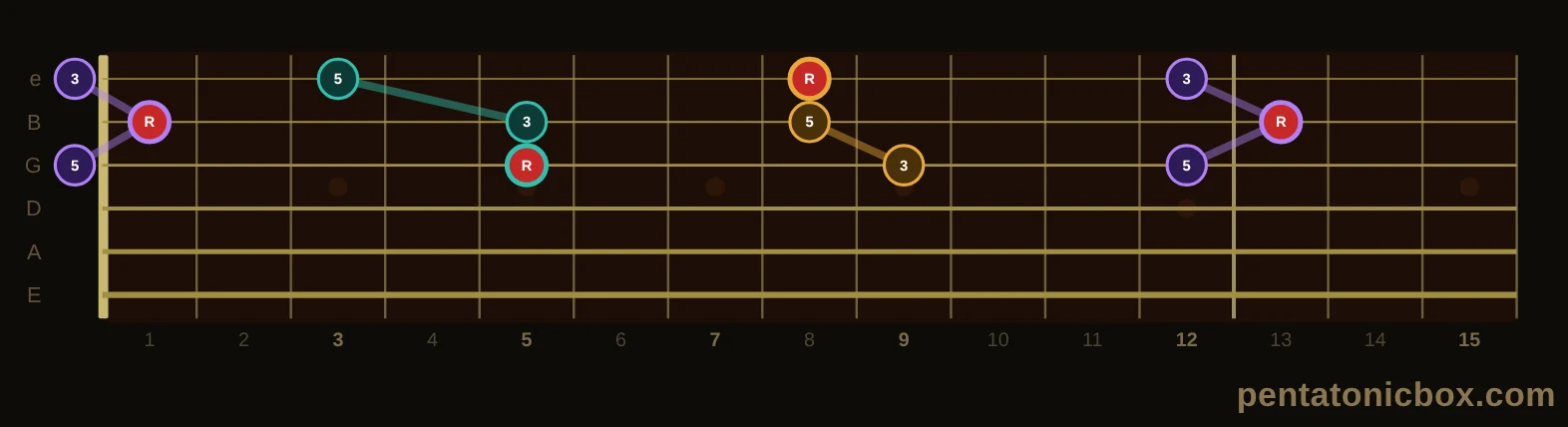
A triad is a three-note chord: the root, the 3rd and the 5th. On guitar you play one note on each of three neighboring strings, and every chord has three shapes — its inversions — that repeat up the neck. Learn them on each set of three strings and you can play any major or minor chord anywhere on the fretboard, which is the backbone of rhythm parts, funk and soul comping, and soloing that follows the chords.
| Inversion | Lowest note | Order, low string to high |
|---|---|---|
| Root position | The root | R · 3 · 5 |
| 1st inversion | The 3rd | 3 · 5 · R |
| 2nd inversion | The 5th | 5 · R · 3 |
All three use the same three notes. Moving up the neck on one string set, the shapes come in order — root position, 1st inversion, 2nd inversion — and then repeat an octave higher.
Root position: frets 3–5 · 1st inversion: frets 8–9 · 2nd inversion: frets 0–1 and frets 12–13.
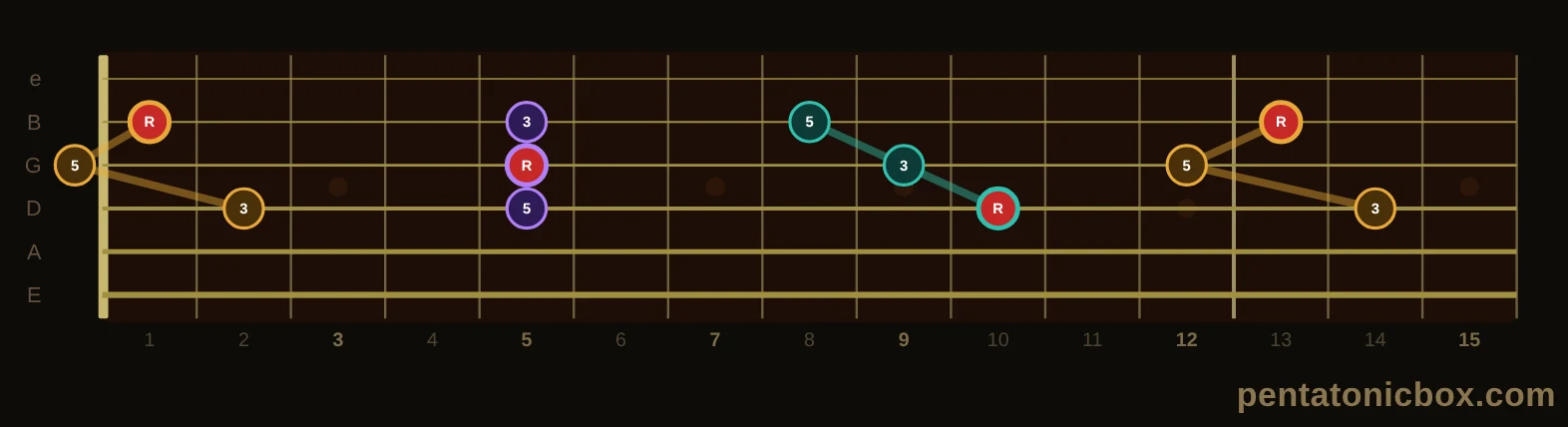
Root position: frets 8–10 · 1st inversion: frets 0–2 and frets 12–14 · 2nd inversion: fret 5.
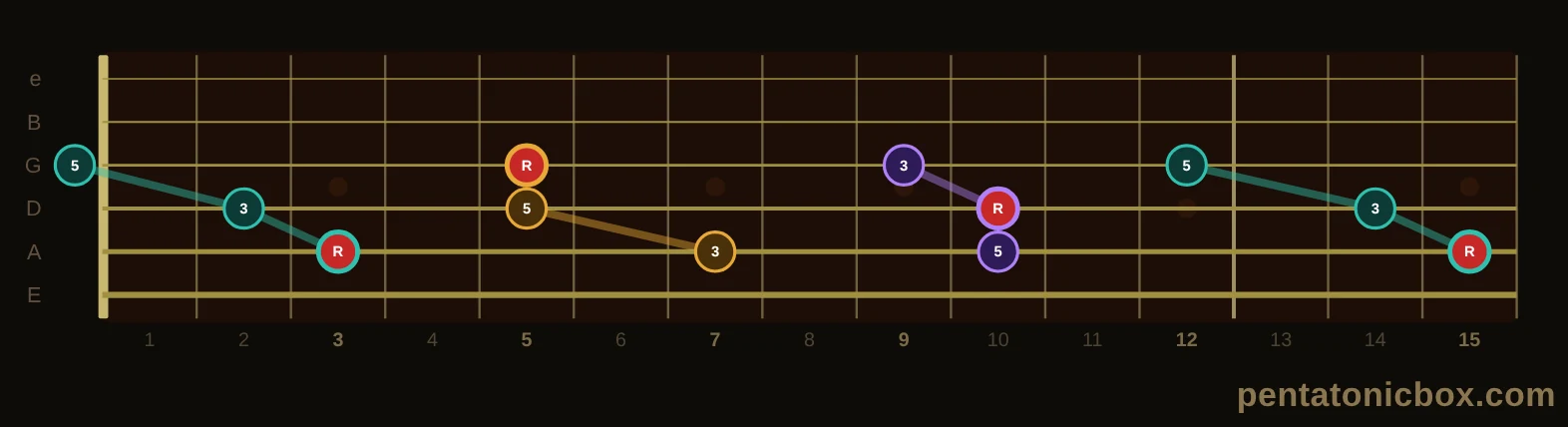
Root position: frets 0–3 and frets 12–15 · 1st inversion: frets 5–7 · 2nd inversion: frets 9–10.
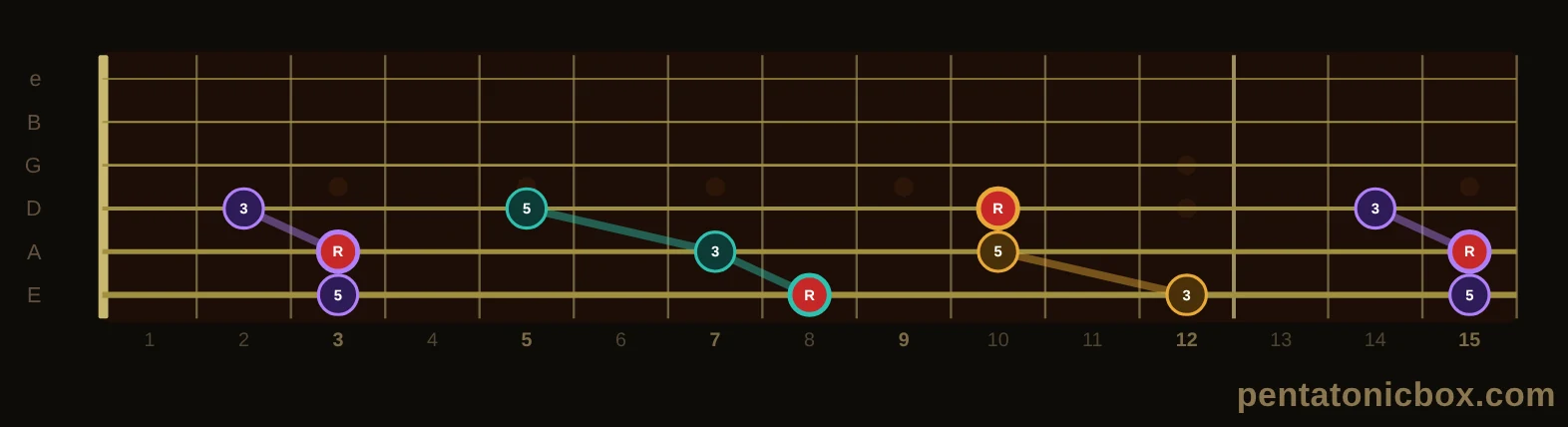
Root position: frets 5–8 · 1st inversion: frets 10–12 · 2nd inversion: frets 2–3 and frets 14–15.
To turn a major triad into a minor one, lower the 3rd by one fret. Here is A minor on the top three strings — the same three shapes, each with a flattened 3rd.
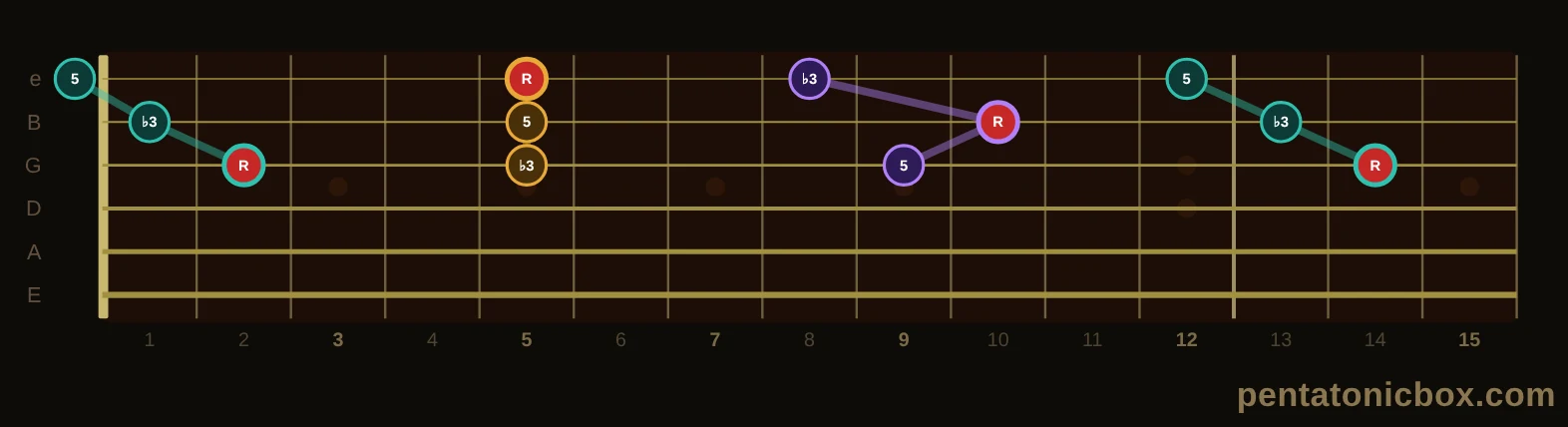
Root position: frets 0–2 and frets 12–14 · 1st inversion: fret 5 · 2nd inversion: frets 8–10.
Two more triads round out the set. Each changes one note of a major or minor triad, so the shapes stay close to the ones above.
| Triad | Change from major or minor | Formula |
|---|---|---|
| Diminished | Minor triad with the 5th lowered one fret | R · ♭3 · ♭5 |
| Augmented | Major triad with the 5th raised one fret | R · 3 · ♯5 |
The augmented triad is symmetrical: its notes are evenly spaced, so the same shape repeats every four frets.
A major triad (1, 3, 5) sits inside the major pentatonic scale (1, 2, 3, 5, 6), and a minor triad (1, ♭3, 5) sits inside the minor pentatonic (1, ♭3, 4, 5, ♭7). So every pentatonic box already contains the chord's triad shapes. Aiming your phrases at triad notes is the simplest way to make a pentatonic solo follow the chords. See it in the C major pentatonic and A minor pentatonic charts.
Play a triad's notes one at a time across all six strings and you have an arpeggio. Add a 7th and you get the major 7, minor 7 and dominant 7 sounds of jazz, soul and blues. See all nine core shapes on the guitar arpeggios page.
Every triad shape is a slice of a bigger chord shape. Take three neighboring strings from a C, A, G, E or D chord shape and you have a triad in one of its inversions. The CAGED system shows those five full shapes up the neck and which pentatonic box each one sits in.
Every key has its own page with all 12 shapes (3 inversions on 4 string sets) and the chords that go with it.
A triad is a three-note chord made of a root, a 3rd and a 5th. On guitar it is usually played on three neighboring strings, one note per string.
An inversion changes which chord note is lowest. Root position has the root on the bottom, 1st inversion has the 3rd on the bottom, and 2nd inversion has the 5th on the bottom. All three use the same notes.
The top three strings, G–B–e. The shapes are small, they cut through a band mix, and they are the most common triads in rock, pop and funk parts. Then move to D–G–B.
A power chord is only the root and the 5th, with no 3rd, so it is neither major nor minor. A triad adds the 3rd, which is what makes a chord sound major or minor.
Yes. Pro shows major, minor, diminished and augmented triads in all 12 keys, in every inversion and on every string set, plus nine arpeggios.