The minor pentatonic is the most-used scale in rock and blues guitar. It has five notes — the root, minor 3rd, 4th, 5th and minor 7th — and leaves out the two notes of the natural minor scale (the 2nd and ♭6th) that clash most easily with the chords underneath. That is why almost anything you play with it sounds right.
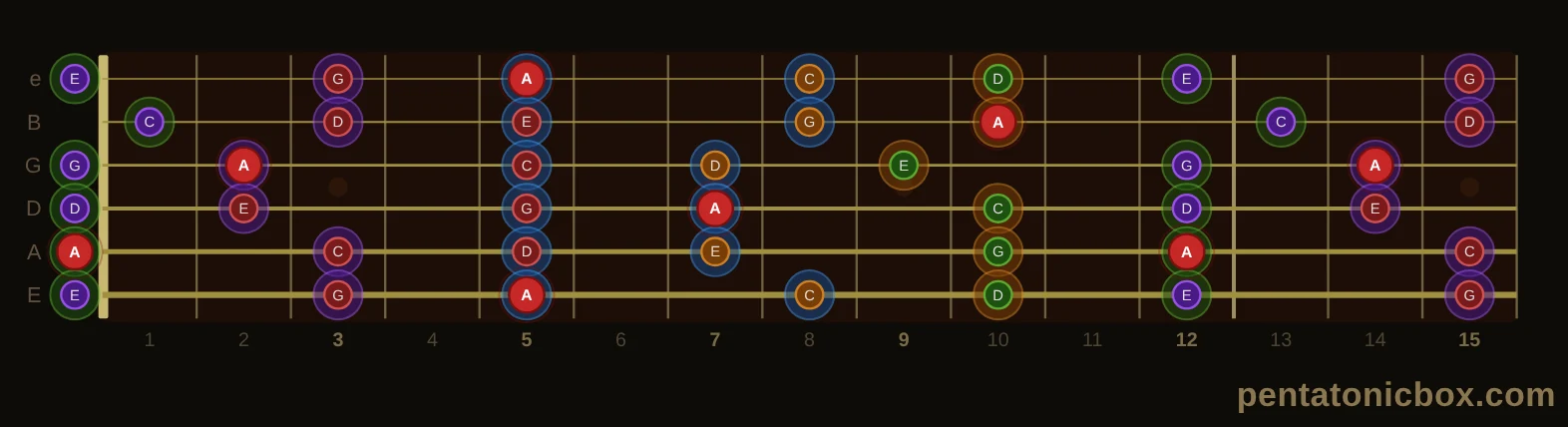
On guitar it is played as five box shapes that link together across the whole neck. The shapes never change from key to key: move them up or down the neck and you are in a new key.
Take any natural minor scale (1 2 ♭3 4 5 ♭6 ♭7) and drop the 2nd and the ♭6th. In A, the natural minor scale is A B C D E F G; the minor pentatonic is A C D E G.
A minor pentatonic from the open strings to fret 15. Each color is one box; red dots are the root, A.
Box 1 is the shape most guitarists learn first. In A minor it sits at frets 5–8, with the root under your first finger on the low E string:
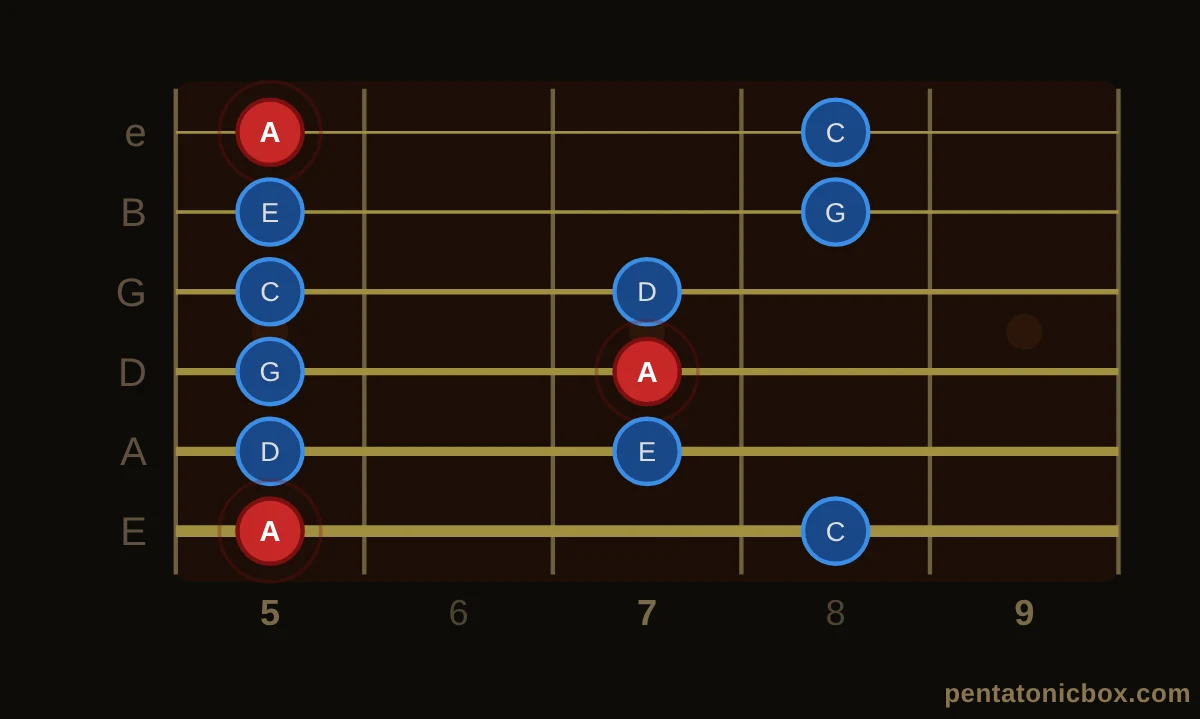
Box 1 in A minor. The root A is at fret 5 on the low E and high e strings and fret 7 on the D string. Every A minor box →
Use one finger per fret: first finger on the lowest fret of the box, pinky on the highest. Box 3 spans five frets, so stretch or shift your hand by one fret on that box.
To play in a new key, find the root on the low E string and start Box 1 there. Each key below links to a full page with all five boxes, diagrams and a free printable chart.
| Key | Notes | Root on low E (fret) | Box 1 (frets) |
|---|---|---|---|
| A minor | A · C · D · E · G | 5 | 5–8 |
| Bb minor | Bb · Db · Eb · F · Ab | 6 | 6–9 |
| B minor | B · D · E · F# · A | 7 | 7–10 |
| C minor | C · Eb · F · G · Bb | 8 | 8–11 |
| C# minor | C# · E · F# · G# · B | 9 | 9–12 |
| D minor | D · F · G · A · C | 10 | 10–13 |
| Eb minor | Eb · Gb · Ab · Bb · Db | 11 | 11–14 |
| E minor | E · G · A · B · D | open / 12 | 0–3 |
| F minor | F · Ab · Bb · C · Eb | 1 | 1–4 |
| F# minor | F# · A · B · C# · E | 2 | 2–5 |
| G minor | G · Bb · C · D · F | 3 | 3–6 |
| G# minor | G# · B · C# · D# · F# | 4 | 4–7 |
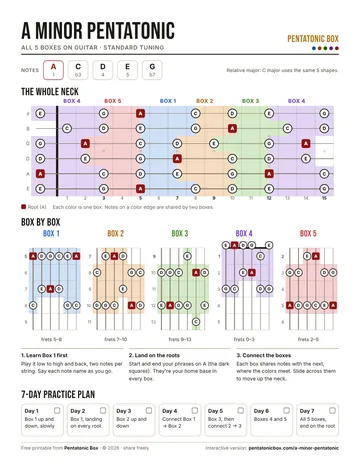
Every minor and major pentatonic key on its own page, plus fretboard notes and CAGED. Print the keys you need.
Download all charts All 26 free charts →Every minor pentatonic shares its notes with a major pentatonic three frets higher: A minor pentatonic and C major pentatonic are the same five notes. Treat A as home and it sounds minor; treat C as home and it sounds major. See the major pentatonic scale and how to mix the two.
Add the ♭5 (the "blue note") to the minor pentatonic and you get the blues scale: A C D E♭ E G in A.
Learn how to practice the boxes, then connect them across the neck, and finally break out of the box with the notes outside it.
The minor pentatonic formula is 1, ♭3, 4, 5, ♭7. It is the natural minor scale with the 2nd and ♭6th removed.
A, C, D, E and G.
There are 5 box shapes. Together they cover the whole neck, and the same 5 shapes work in every key — only the starting fret changes.
Box 1, which starts on the root on the low E string. In A minor it sits at frets 5–8.
Almost. The blues scale is the minor pentatonic plus one extra note, the ♭5 (blue note).