"Stuck in the box" is the most common soloing complaint on guitar. You know the pentatonic shapes, but your solos run up and down the same five frets and sound the same every time. The box isn't the problem; staying in one spot and using only its five notes is. Here are six ways out, from easiest to hardest, each one something you can practice today.
The fastest way out of Box 1 is into Box 2. The boxes overlap, so the top notes of one box are the bottom notes of the next. Slide across those shared notes and you have doubled your range without learning anything new. The full method, with every box pair, is on how to connect the pentatonic boxes.
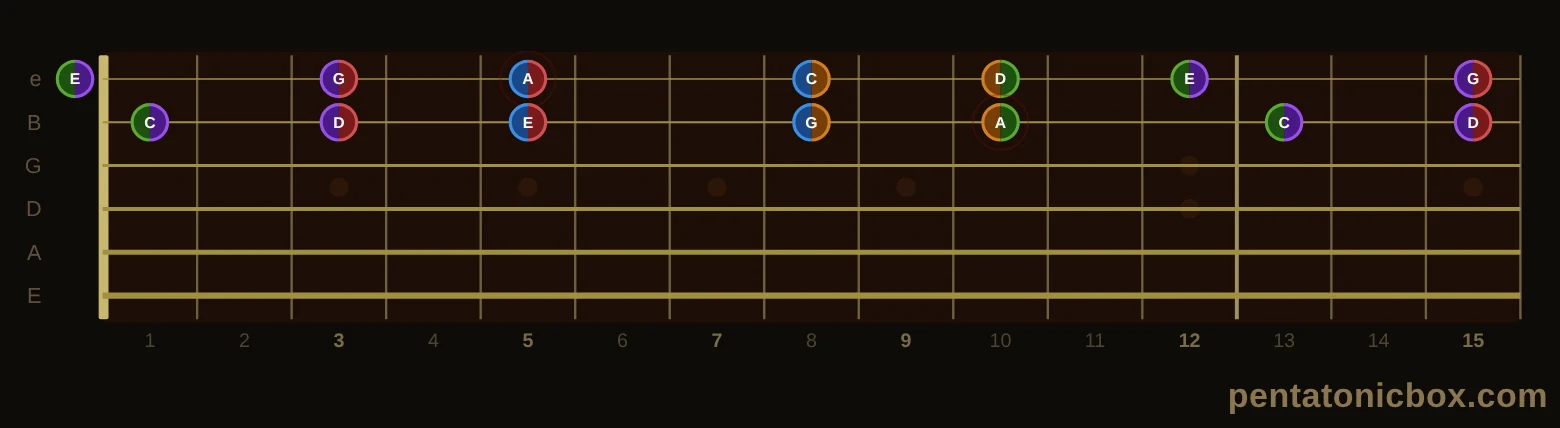
Boxes teach you to play across the strings. Great solos also move along them. Take just the top two strings and play the scale from the open strings to the 15th fret. You will pass through all five boxes, sliding between notes instead of jumping across strings.
A minor pentatonic on the high e and B strings only. Slide between neighboring notes with one finger to hear how it connects the boxes.
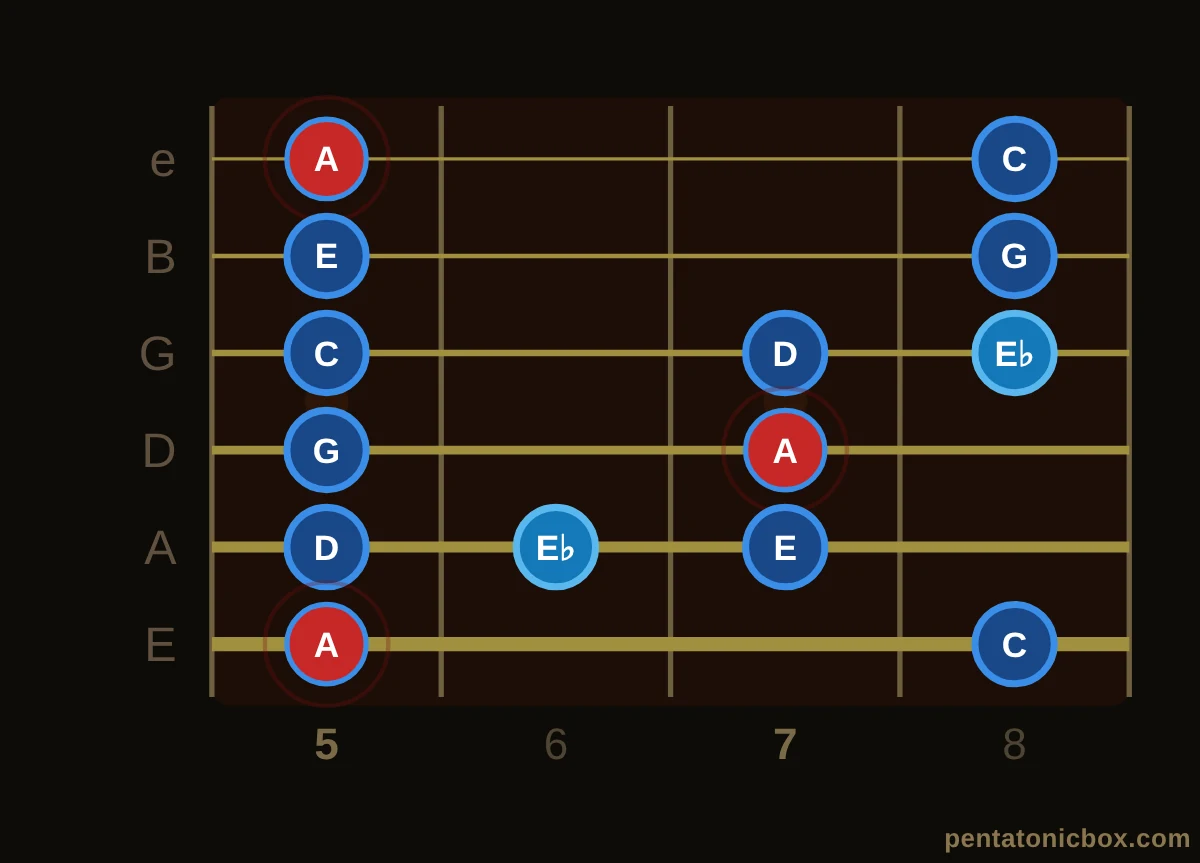
The blue note (the ♭5, E♭ in A) sits between the 4th and 5th of the minor pentatonic. It isn't in the scale, so it adds instant tension and the classic blues sound. Use it as a passing note: slide or hammer through it on the way to the 5th, never sit on it. In Box 1 it is on the A string fret 6, G string fret 8.
Over a blues or a dominant 7 chord, mixing in a few major pentatonic notes (especially the major 3rd, C♯ in A) makes a minor pentatonic solo sound sweeter and more melodic. This is how B.B. King and Eric Clapton phrase. The full guide: mixing major and minor pentatonic.
A solo sounds like it follows the music when your phrases end on notes of the chord. Inside every A minor pentatonic box are the notes of the A minor 7 chord (A, C, E, G). Learn where they are with the A minor 7 arpeggio and the A minor triads, then end each phrase on one of them.
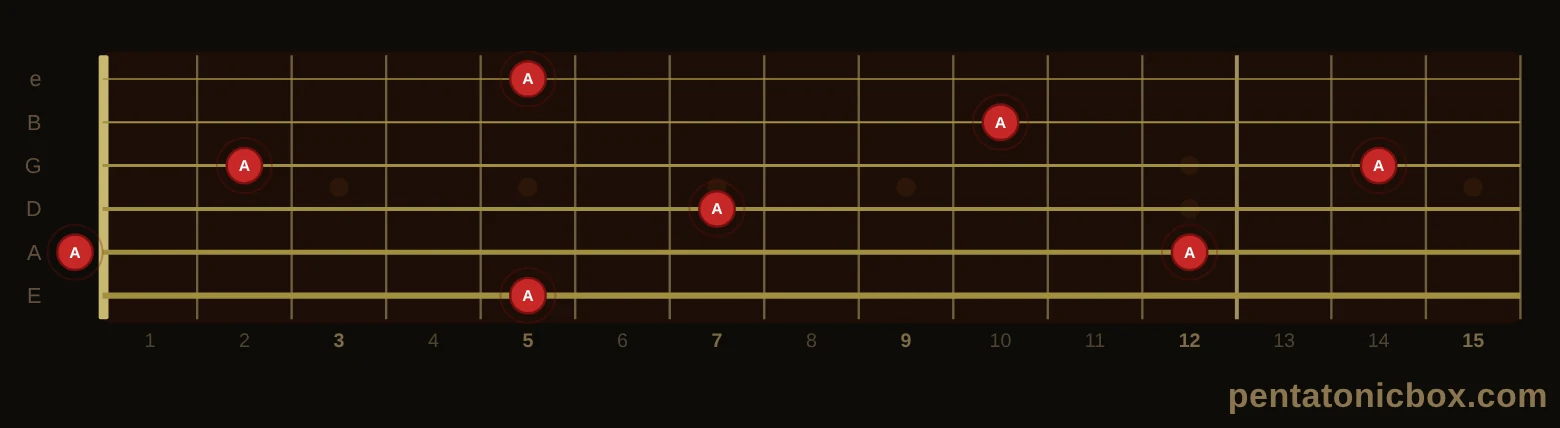
If you can see every A on the neck, you can start a lick from any of them and the box around it follows. This map shows every root from the open strings to the 15th fret. The two-octave shapes repeat, so you only need a few patterns. More on finding notes: how to learn the notes on the fretboard.
Connect each box to the next using their shared notes, play along one or two strings instead of across them, and add notes outside the scale such as the blue note and the major 3rd.
The flat 5th. In A minor pentatonic it is E flat, between D and E. Use it as a passing note rather than a note to rest on.
Yes, but one pair at a time. Knowing all five lets you play the same idea anywhere on the neck instead of being tied to one position.
No. The boxes are the map; getting stuck happens when you only use one box and only its five notes. The ideas on this page build on the boxes instead of replacing them.
More guides: pentatonic boxes guide · connecting the 5 boxes · learning the fretboard notes · mixing major and minor pentatonic · left-handed scale charts · guitar modes explained.